


Tips & Advice
Jewelry & watch care
Tout ce qu'il faut savoir pour garder vos pièces éclatantes — à la maison et en boutique.
A well-maintained piece of jewellery retains its brilliance for generations. A well-serviced watch stays accurate for decades. Yet each metal, each stone and each watch movement requires different care.
This guide gives you the right gestures to make at home — and tells you exactly when it is better to entrust your pieces to a professional. Because between a soft cloth and an ultrasonic cleaner, there is a world of difference.
Caring for your gold jewellery
Gold does not tarnish like silver, but it accumulates a thin layer of body oils, soap and cream that gradually veils its brilliance. A few simple gestures are enough to restore its shine.
Home cleaning
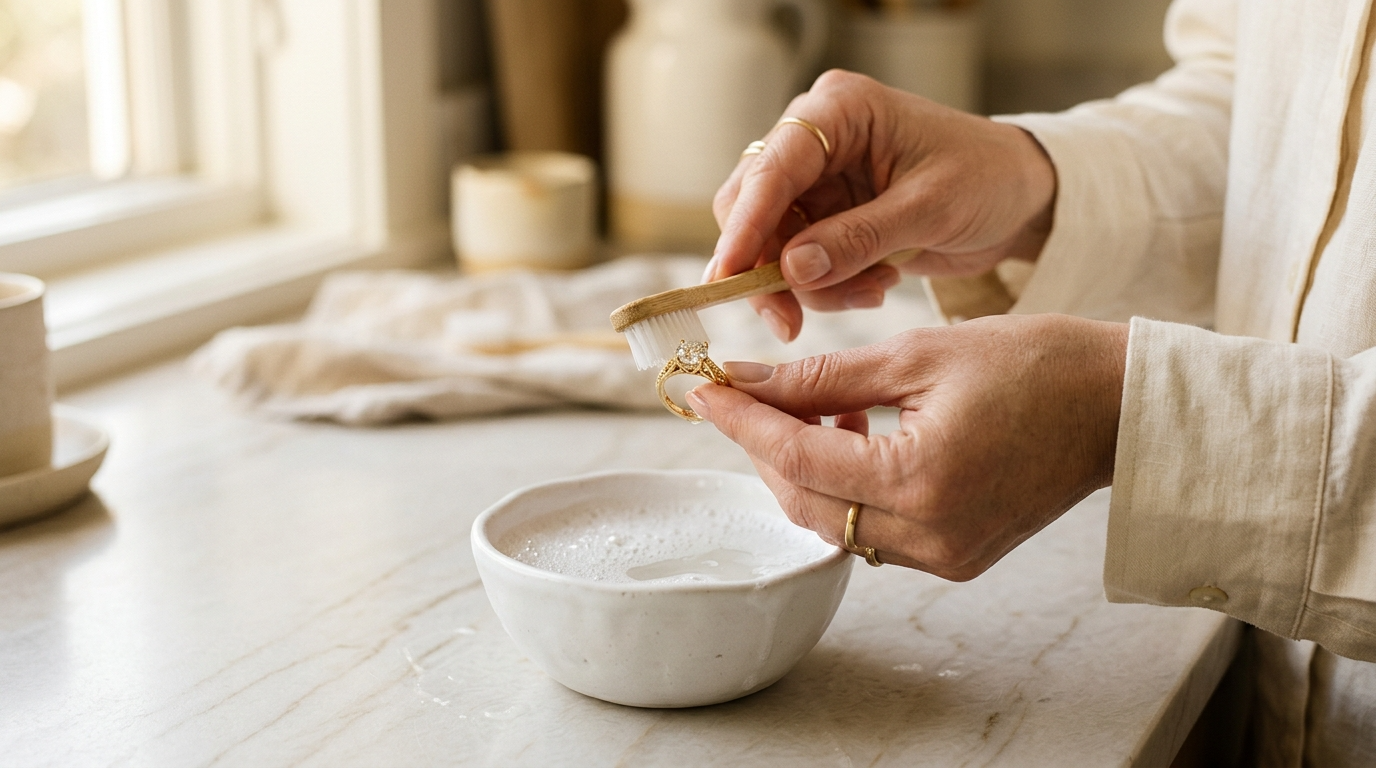
Prepare a bath of lukewarm water with a few drops of mild dish soap (unscented). Soak your jewellery for 5 to 10 minutes. Scrub gently with a soft toothbrush — pay attention behind the settings, where dirt accumulates most. Rinse in a bowl of clean water (never directly over the sink) and dry completely with a soft cloth. This method works for yellow gold, white gold and rose gold.
The special case of white gold
White gold is coated with a thin layer of rhodium that gives it its brilliant silver shine. With daily wear, this coating wears away — the piece then takes on a slightly yellowish or warm tone. This is normal. Rhodium re-plating by your jeweller (roughly every 1 to 3 years depending on wear) restores its like-new appearance in a few minutes.
What to avoid
Remove your gold jewellery before the pool (chlorine attacks the alloy), the gym (sweat combined with friction wears the alloy) and applying perfume or cream (chemicals). Apply your cosmetics first, then your jewellery.
"Gold is a forgiving metal — it tolerates a lot. But chlorine is not forgiving. I have seen 14K wedding bands crack after a summer of daily swimming. Remove your jewellery before you dive in."
Caring for your silver jewellery
Silver tarnishes — that is proof it is real. The good news: tarnishing is 100% reversible.
Polishing cloth
A quick wipe after each wear is enough for routine care. Buff in one direction to avoid micro-scratches. It is the gentlest and most effective method for silver worn regularly.
Lukewarm water + mild soap
Same method as for gold. Dry completely — water marks leave spots on silver. Ideal for a monthly clean as routine maintenance.
Baking soda + aluminium foil
For heavy tarnishing: line a bowl with aluminium foil (shiny side up), add 1 tbsp baking soda, pour in boiling water, place your jewellery in the bath for 2–3 minutes. The chemical reaction transfers the tarnish to the foil. Rinse and dry.
Avoid this method on jewellery with glued stones, pearls or intentional oxidised finishes.
Storage
Store in an anti-tarnish pouch or individual zip-lock bag with a silica gel sachet. Avoid rubber (it contains sulphur).
To learn everything about 925 silver, read our complete guide to sterling silver — coming soon.

Caring for your diamonds and gemstones
Diamonds
Diamond is the hardest stone, but it attracts grease like a magnet. A dirty diamond loses much of its brilliance. Clean it regularly: a bath of lukewarm soapy water, a gentle scrub behind the setting (that is where dirt accumulates most), a rinse in a bowl of clean water, and a dry with a cloth.
Delicate stones
Emeralds, opals, turquoises and tanzanites are sensitive to heat, thermal shock and chemicals. Never put them in an ultrasonic cleaner. Clean them only with a soft, slightly damp cloth. If in doubt about your stone, bring it to Diplomate — we will tell you exactly how to care for it.
Prong check
The prongs holding your stones wear down over time. Gently shake your ring near your ear: if you hear a faint clicking, the stone is moving. Have the prongs checked by a jeweller every 6 to 12 months — it is the best insurance against losing a stone.
A worn prong or a stone that moves? Our workshop handles jewellery repair on site.
Caring for your pearls
Pearls are organic — they breathe, they absorb, and they are far more delicate than gemstones.
- Apply perfume, hairspray and cream before putting on your pearls.
- Wipe them after each wear with a soft, slightly damp cloth.
- Never soak them — water can weaken the thread.
- Store them flat, separated from other jewellery, in a soft fabric pouch (not airtight plastic — pearls need a little ambient moisture).
- Have the thread re-strung every 1 to 2 years if worn regularly — a worn thread is a necklace broken at the worst moment.
"Pearls are the most personal jewellery — they literally adapt to your skin over time. But they hate two things: perfume and neglect. Wear them often, and they will keep their natural lustre."

Caring for your watches
Daily care
Wipe the case and bracelet with a microfibre cloth after each wear — perspiration and dust accumulate in the links. If your watch is water-resistant, you can slightly dampen the cloth. Never submerge a non-water-resistant watch.
Quartz watch — the battery
A quartz watch battery lasts on average 2 to 5 years. Signs it is weakening: the seconds hand jumps in 2 to 4-second intervals (instead of one second at a time), or the digital display fades. Never leave a dead battery in a watch — it can leak and corrode the movement. Have the battery replaced by a professional: they will also check the water-resistance seals.
Mechanical or automatic watch — the service
A mechanical movement is a set of precisely lubricated moving parts. Over time, the oils degrade and friction increases. A full service (disassembly, cleaning, lubrication, regulation, seal replacement) is recommended every 3 to 5 years. It is the best investment for extending the life of your watch.
Water resistance — what the numbers really mean
| Marking | What it really means |
|---|---|
| Water Resistant (WR) | Splashes only |
| WR 30M | Shower, rain |
| WR 50M | Light swimming |
| WR 100M | Snorkelling |
| WR 200M+ | Scuba diving |
Important: water resistance is not permanent. Seals age. Have the water resistance tested once a year, especially if you wear your watch at the pool or the sea.
Battery replacement or full service? Discover our watch repair service.
Your maintenance schedule
| What | At home | At the jeweller |
|---|---|---|
| Jewellery cleaning (gold, silver) | After each wear (soft cloth) | Every 6–12 months (ultrasonic + polish) |
| Prong check | — | Every 6–12 months |
| Rhodium re-plating (white gold) | — | Every 1–3 years |
| Pearl re-stringing | — | Every 1–2 years |
| Battery replacement (quartz) | — | Every 2–5 years |
| Mechanical watch service | — | Every 3–5 years |
| Watch water resistance test | — | Annual |
This schedule is a general guide. Each piece is different — come see us for a personalised assessment.
Frequently asked questions
Non. Le dentifrice contient des micro-abrasifs qui rayent l'or, l'argent et les pierres tendres. Pour un nettoyage maison sécuritaire, utilisez de l'eau tiède avec un savon à vaisselle doux et une brosse souple — c'est tout ce qu'il vous faut.
Oui. L'or blanc est naturellement légèrement teinté — c'est la couche de rhodium qui lui donne son éclat argenté brillant. Quand cette couche s'use, la teinte naturelle de l'or réapparaît. Un replaquage rhodium (rapide et abordable) lui redonne son aspect neuf. Selon le port, cela se fait environ tous les 1 à 3 ans.
Tous les 6 à 12 mois pour une vérification des griffes et un nettoyage professionnel. C'est particulièrement important pour les bagues de fiançailles et les bijoux portés au quotidien. Une griffe usée non détectée peut entraîner la perte d'une pierre.
Le vinaigre peut fonctionner sur l'or jaune pur, mais il risque d'endommager les perles, les pierres poreuses et certains alliages. Par précaution, tenez-vous à l'eau tiède savonneuse — c'est le nettoyant universel le plus sûr pour la grande majorité des bijoux.
Possiblement. Sur une montre à quartz, un retard ou une trotteuse qui saute par intervalles de 2 à 4 secondes signale une pile faible. Sur une montre mécanique, un retard peut indiquer que les huiles du mouvement ont besoin d'être renouvelées — une révision complète est à prévoir.
On ne le recommande pas. Le savon laisse un film sur l'or et les pierres, le chlore de l'eau peut ternir l'argent, et l'humidité prolongée affaiblit le fil des perles. Prenez l'habitude de tout retirer avant la douche — vos bijoux dureront bien plus longtemps.
Non. « 30M » signifie résistance aux éclaboussures et à la pluie seulement. Pour la baignade, il faut au minimum 50M. Pour la plongée en apnée : 100M et plus. Et n'oubliez pas de faire tester l'étanchéité une fois par an — les joints vieillissent même sans immersion.
Secouez doucement votre bague près de votre oreille. Si vous entendez un léger cliquetis, la pierre bouge dans son sertissage. Cessez de porter le bijou immédiatement et apportez-le chez un joaillier rapidement — une griffe défaillante se répare facilement, une pierre perdue beaucoup moins.
Passez nous voir au 1144, avenue du Mont-Royal Est pour une évaluation gratuite. Les prix varient selon le type de bijou et le travail requis, mais un nettoyage et polissage de base est accessible et rapide. Appelez-nous au 514 524-2233 pour une estimation.
Oui. Nous remplaçons les piles sur place, avec vérification des joints d'étanchéité. Sans rendez-vous obligatoire, en quelques minutes. Appelez-nous au 514 524-2233 pour confirmer la disponibilité pour votre modèle.
Professional cleaning?
Polissage, nettoyage aux ultrasons, remplacement de pile, vérification des griffes — passez nous voir au 1144, avenue du Mont-Royal Est.
In store
1144 Avenue du Mont-Royal Est
Montréal, QC H2J 1X8
(514) 524-2233
Tue–Fri: 10:30am–6pm
Sat: 10:30am–5pm
Sun–Mon: Closed